

Exactly 512 days ago, I wrote about Optionality.
58 days before I was laid off (the company was shut down months later).
So, here I am, about 15 months into what I imagine many of you are also navigating, about to navigate, or possibly trying to avoid:
Being a “fractional” professional (in the midst of micro, meso, and macro chaos, complexity, and heartache - s/o Sam Spurlin for this layered framing)
Pioneered by “freelancers” and “contract” workers well before this moment, the idea that any -and possibly all- white collar jobs could be fractional is at once liberating (the freedom! the flexibility!) and frustrating (benefits, healthcare, taxes; context-switching, selling, invoicing, system-switching; feeling pulled to be always-on; hyper conscious of time away from family).
Just this morning in the Financial Times, global business columnist and associate editor Rana Foroohar posited this in her headline: “America’s gig economy: Self-employment, at both the high and the low end, is keeping consumption afloat — but for how long?” And in her piece, notes:
While that implies flexibility and entrepreneurialism, it also may mean an economy in which labour markets — and growth — will be more volatile and precarious than in the past.
In the final sentence of Foroohar’s piece, a word I hadn’t seen before leapt off the page, in the context of cautioning what might happen to the economy if this class of people stops spending:
the precariat class
What I thought was a witty portmanteau she surely made up (combining precarious and proletariat - genius!), has actually been in circulation for the better part of the last 15 (!) years.
Digging into the citations for precariat on Wikipedia had me encountering headlines like:
"Who will be a voice for the emerging precariat?" (2011)
from what seems to be the originator of the term Guy Standing - side note: what an aptronym he has with that name oooohweeee
“Plutonomy and the Precariat” (2012)
“We’re All Precarious Now” (2015)
I mean, I know about Universal Basic Income and the concept of structural unemployment and the rise of disaffected workers showing up as Sanders-Trump and Trump-Mamdani and all… but how the eff did I miss this word:
PRECARIAT
And, then it hit me.
It’s so obvious with hindsight: my full time employment privileges.
That’s how.
Full time in industries and companies who -from roughly the mid aughts to 2019- were in their “white hot space” (to quote Jay-Z)
In industries and companies, who, in many ways, helped usher in this moment.
Ooof.
What a gift to be employed with a safety net of benefits during those years; and, also, how harrowing it is to look back knowing what I know now.
As with all of my posts here at Turtle Adventures - it’s my aim to share the ups, downs, and compasses I am using / have used to navigate a world not built by or for us… but that we will be damned if we don’t make it better for one another (as Turtles), while still trying to get the bag.
And so, let me share what I am taking forward into my second year in this liminal-but-could-end-up-being-permanent-space branded as “fractional” but could also be thought of as a part of the (growing) “precariat” class.
Here’s what I know so far:
I am built for going fractional. I have made a career out of moving between industries, social classes, and business models. In many ways, I feel built for this moment and am grateful that ladders gave way to jungle gyms long ago. I trust in what and who I know, and that when I swing and reach for the next rung, I will find it—and it will find me.
I am prepared for fractional. Before there was Slack and before there was the pandemic, I was running a distributed, virtual team to create amazing outcomes from 2006–2012. What I called “The Agency of the Future” in 2011 is, well, just how we work now. It feels like a homecoming to work across timezones, platforms, email accounts, projects, industries, clients, and contexts. I have also long been responsible for revenue generation, so this feels like the same song—just a different verse.
I am still trying to accept being fractional. Even if I feel built and prepared for it, not having the 3Bs (base, bonus, and benefits) of yore couldn’t have come at a worse time.
A time, when, I have stepped into the primary earner role in my family, with a toddler at home and having not ruled out having more kids (s/o to my 36 year old self who gave me options). So now is when the ushering in of precarity is in full swing for white collar job? now it’s become unbundled, just like cable and our homes-as-b-n-n’able?
Why couldn’t this cataclysmic shift held off another decade or two?
I bet every generation of workers has wanted to stave off major shifts in some way, somehow - just like I do in this moment.
It’s just now that it’s come for me and my career. How silly I was to think I could outrun it, with enough hard work and education.All that to say: I am choosing to embrace this moment, however long I am in it, and keep my FTE antennae up just in case there’s an opportunity to put down roots.
And so, how ever long “Fractional” stays in our lexicon, whether it evolves to become the new norm or whether we “go back to the old way,” here at TRTL I want us to be ever prepared, ever buoyant, and ever flexible in these choppy and chopped-up professional seas.
With this as a backdrop, I wanted to share 6 things that kept me afloat in the last 454 days in hopes that they may help, in some small way, midwife you through this season, too…
6 Truths as a Fractional Professional
From a hard-fought 2025 season out in these mean, unbundled streets, comes a stronger 2026 (so far).
1. Never say never.
There were industries I wasn’t sure I’d ever work in, or work in again, yet in 2025 and 2026: they came knocking and I answered. Similarly, I’ve had folks I’ve known for 10, even close to 20 years, re-cross my path this year that have turned into fruitful collaborations. I am glad I’ve stayed open and connected.
2. Develop and iterate your own digital & sales strategy.
For someone who has helped brands run their digital strategies and revenue for my whole career, it’s a little embarrassing to say: I had’t actually stepped back to architect my own approach to the socials + to ye olde sales in this modern moment.
For my approach to digital platforms, I used something the ace team of NIKEiD folks and I came up with for myself here (“Purpose to Platform”).
I also took the wise advice many have about problem-based selling and repositioned my services when I relaunched my website earlier this year: lesliebradshaw.com
And, finally, I use my homemade Pipeline Tool on a weekly basis to track, qualify, and advance opportunities.
3. Package up and monetize your how.
I am turning some of my evergreen, ‘best of’ tools from the last 20 years into Figjam + Miro frameworks, GSheet + GDoc templates, and even AI prompts that have become ways of both delivering outcomes for my clients -as well as- themselves being the outcome.
I’ve long been a fan of the “cookbook” model, in which you can give away your recipes to a broader part of the market -and- operate a few more higher-price point “restaurants” that you chef. Both channels serve each other with deal flow and in-market learnings, too.
It’s a play I ran as a speaker/blogger/agency owner 2006-2016; and now I am adding some more scaffolding to further professionalize what know and want to share with others here in 2026+ (it’s also something Jesus stays be telling me - you are 100% right babe).
4. Create for exploration, not just for transaction.
Over the last year-plus, I’ve had a blast…
writing things I haven’t yet published (drafts are my love language)
trying out new platforms (like TikTok)
making collages with my daughter out of magazines and ripped books
propagating houseplants
developing my Idea Garden
being in community with thinkers and doers
going entirely offline and analog whenever I can (weekends; no phone hangs, etc.)… though the ‘working for yourself’ makes this SUPER HARD
executing my purpose to platform digital strategy referenced above - with various handles/profiles available to me as sandboxes without the pressures of performing on more familiar stages (i.e., LI, IG, FB).
I’ve even been playing around with AI a fair amount (will share in another post at some point)
All that to say: It’s nice to do these things without pressure of a client, a deadline, or a deliverable.
I am making things that might not ever be seen or engaged with - and in lowering the pressure, I think I am removing (some of) the performative nature of creating for an audience.
What if you just created for yourself?
What if, like Jasmine Bina wrote over the weekend, when you write for the 5th or 6th time about something in public, you let it be confusing before jumping to clarity?
“What that teaches me is that if I really want to understand my thoughts, I have to be willing to be misunderstood by people.” -Jasmine Bina
5. Find and honor resonance.
There are rooms and people that feel like home, while there are others that feel like deserts (one S).
I am tuning my practice of noticing: when am I hydrated vs. when do I have to contort to fit a situation?
We can’t always be hydrated and fitting in without belonging is often something we must do in order to make a living - however, the older I get, the more careful I am about observing, managing, and even storing energy to move between these two poles. I feel so strongly about this point, I wrote up a “Recipe” list for Transformative Collaborations over on LinkedIn.
Sit with this question: where do you go to (deep) think. And maybe put it in conversation (like I did here with Linda Booth Sweeney and Nitzan Hermon)
6. Commune, collaborate, connect with others.
Like many of you, I have been working virtually since mid-March 2020.
Though the rhythm of home has generally been a blessing—through postpartum, new motherhood, night owl’ery—I miss the office; I miss coworkers; I miss co-thinking in 3D.
As an antidote to these misses, I have jumped at the opportunity to travel for clients and industry conferences. I am also part of the Critical Business School faculty in April, where we meet in person in Greenpoint.
Having traveled non-stop for most of my early and mid-career, I welcomed the pause. Until it felt like pond water. Here’s to continued movement in 2026 (including my family coming along for some of the upcoming trips I have! s/o Brian Williams at Viget for the inspiration here)
And speaking of what’s to come in 2026 and beyond:
As the world unbundles white collar jobs, I believe there will be re-sorting and re-bundling to help manage the complexity of coordination -and- the loneliness of being a solo practitioner.
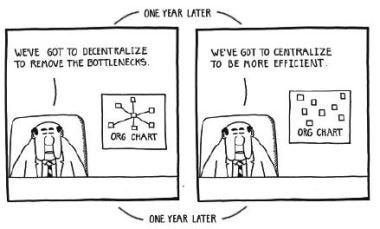
For now, I am thinking of them as communities and collectives.
These are not new, per se, but there does feel like there are a rise of the ‘leadership role’ collectives - most notably for me:
ExCo Group, where I’ve been an executive mentor / coach since 2021;
XcelerateOne, which has been an excuse to work with some of my favorite colleagues from my last full time job; and
Uncommon, where I joined joining as a fractional Chief Growth Officer in January.
Bradshaw Vineyards, which has been my family’s business since 1993.
I continue my community involvement at Crossfit East River (where I met my now partner 10 years ago!)
I continue to appreciate the curation of the ‘being in space’ communities Nitzan Hermon has created (Thirdness, Group, Prompts, as noted above, Critical Business School)
When I look back at this piece in another 512 days, I wonder if I will see Fractional as an evergreen compass I am still using. Or if I will view these musings as a fossil from a time that has long since past.
Or, perhaps, it will be growing in meaning and be, in fact, a living idea.
In the Idea Garden, I am posting it in Evergreen for now.
Special thanks to Katie Harbath, David Armano, Christina Wallace, Jory Des Jardins, and Elisa Camahort Page for being generous with their time and thinking around fractional / portfolio careers over the years. And to Angela Benton who has been adding her pen to this topic to much wit and communing, too!
p.s. as you go Fractional, if you need help tracking your time -or even benchmarking a week or a month to see how things are flowing- download John Davidson’s FRACT app. It’s the +6 minute billing chunks from my law firm days, but way more fun!
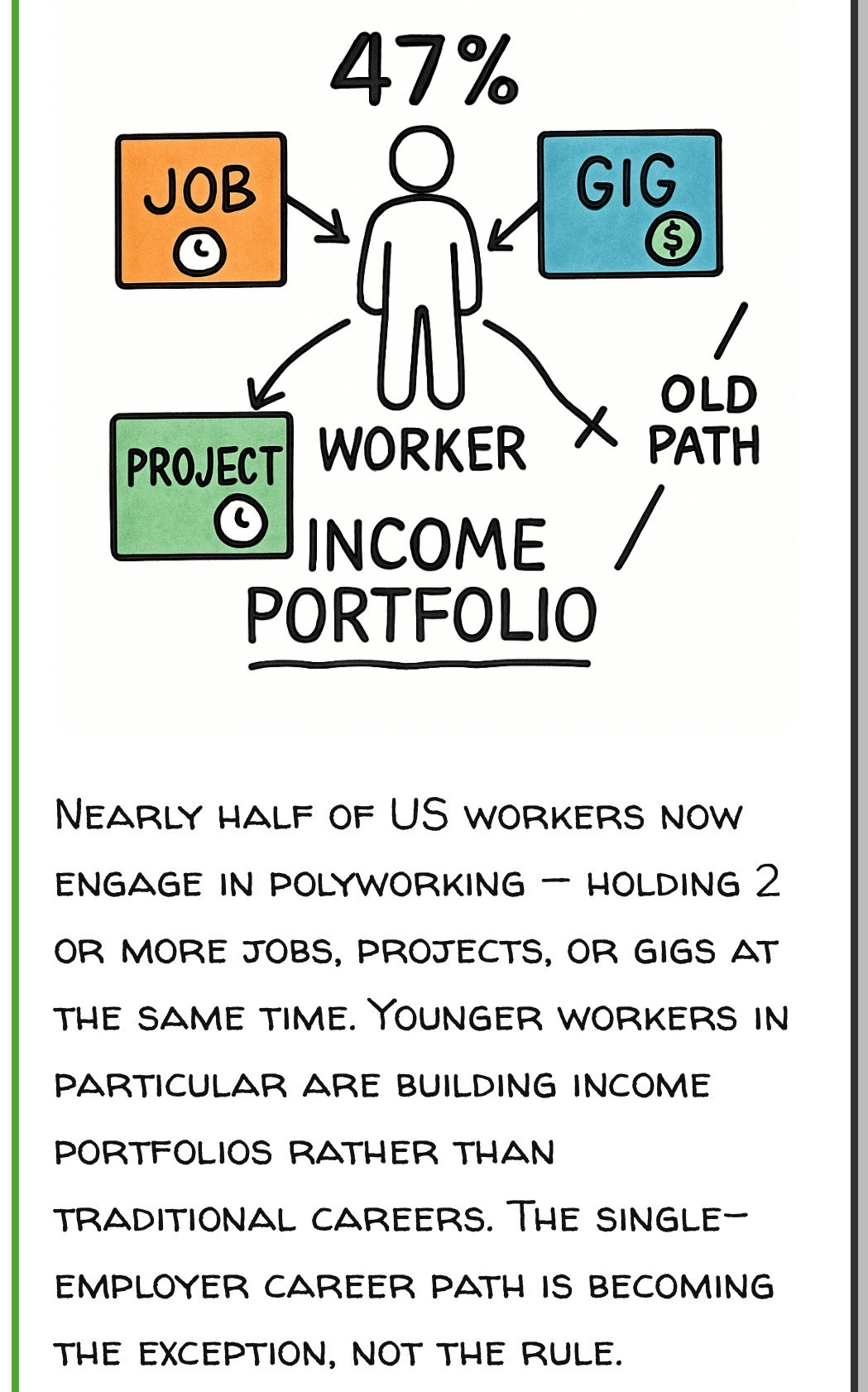
p.p.s. a day after publishing this, the great aforementioned David Armano declared: “Polyworkers are the new fractionals” (image below). Another great articulation of the career unbundling and the continued rise of “the precariat”.
This was a freaking excellent encapsulation of the learnings and calibrations associated with being a fractional. I have to agree--it's decreasingly a choice and increasingly something we're forced to handle, more than a choice these days. And because of this I've had to become more deliberate about finding where I have agency, as you so eloquently describe here. Brava!